




Since Curt Cignetti became Indiana's head coach, the Hoosiers have won 36 out of 40 games, been to the College Football Playoff twice, won a Big Ten title and hung a national championship banner in Memorial Stadium.
Even now, long past the point of Indiana football's new reality becoming normal, it's a staggering achievement with almost no comparison in the history of sports.
But even the best of the best have a blind spot. With Cignetti, it's the schedule. It's always the schedule.
The CFP committee ranked Indiana No. 14 on Tuesday, putting the Hoosiers in a perilous position heading into the final week of the regular season. Though key results around the country will still impact the rankings, and the committee has made some surprising moves at the last minute before, here's the tough part for the Hoosiers: The only way to significantly improve their résumé is by getting into the Big Ten championship game and winning it, which would get them in the field automatically.
Anything short of that will leave the Hoosiers vulnerable. And it's (mostly) their own fault.
Or, to be more specific, it's Cignetti's fault for refusing to acknowledge that non-conference games are important.
With Cignetti, it's not that Indiana has a tough time getting a high-profile opponent to play them. It's not a financial calculation. It's a sneering, unserious contempt for any suggestion that Indiana has a responsibility as a premier program to play non-conference games that are worth watching.
And now it might really cost him.
"We figured we would just adopt the SEC's scheduling philosophy," Cignetti said at Big Ten media day before the 2025 season. "Some people don't like it. I'm more focused in on those nine conference games."
But what if those nine conference games don't give you enough opportunities for good wins?
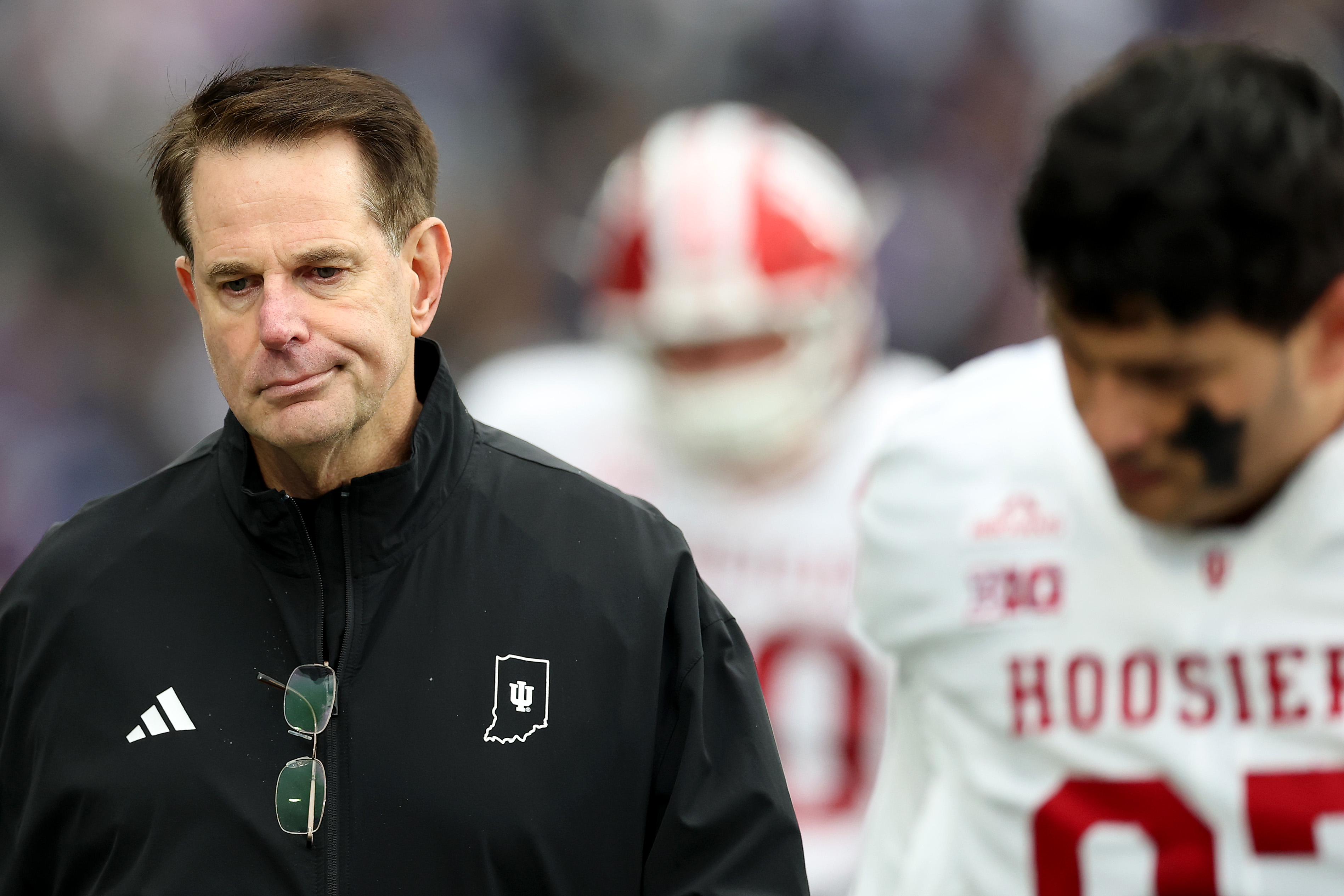
Indiana has had, by all measures, another outstanding season at 9-2. The Hoosiers lost at home to Ohio State because receiver Nick Marsh was barely out of bounds when he caught the would-be winning touchdown and then again last weekend at Washington because it went 1-for-3 on field goals and lost by three points in overtime. By the same token, Indiana has lived on the margins all season, winning four one-score games and pulling off a couple unlikely comebacks. It is probably right about where it should be.
It's not Indiana's fault the Big Ten has had a strange year, but the selection committee can judge only what it sees on tape. Besides a pretty good win over No. 15 Southern Cal, Indiana has nothing else to put in front of the committee and argue that it's done enough to be in the CFP.
Cignetti built a scheduling philosophy around playing nine Big Ten games, thinking that the league would give Indiana enough chances for notable wins. But when the schedule is filled with the likes of Purdue, Northwestern, Nebraska, this year's Michigan team and Minnesota, it's now clear Indiana needed one more shot at a big-time program.
A shot that Cignetti has fundamentally seen as unnecessary to get Indiana football to the top.
"I like winning ballgames," Cignetti told reporters in February of 2025. "I think most coaches do. I mean, we play nine Big Ten Conference games, which is more than most of the other conferences. So I'm going to play who's on the schedule."
But Cignetti, of course, has a large say in who's on the schedule. And he's made it very clear, time and again, that he has no interest in anything other than automatic wins.
At the beginning of his tenure, sure, you can understand it. Indiana football was practically dead, and he's not the first or last coach who has looked at a rebuilding situation and decided that scheduling three non-conference wins can get you halfway to bowl eligibility. When you're trying to just get the program going, it's a smart strategy.
Things changed almost as soon as Cignetti put his first team on the field. Despite the soft schedule accusations, Indiana got to the playoff in Year 1 and won it all in Year 2. Once the program was built to that level, Indiana no longer needed to make things as easy as possible. You could even argue that Cignetti had a responsibility as the steward of a national championship-winning program to find games that help build interest in the sport.
Instead, Cignetti leaned even more into the soft way out — even though his entire persona has been built around not being afraid of anyone.
This year, Indiana scheduled North Texas, Howard and Western Kentucky. Next year's schedule is even more of a disgrace with Jacksonville State, Kennesaw State and Indiana State. In 2028, Miami (Ohio), Austin Peay and Eastern Michigan are on the books. The year after that, it's Ball State, Eastern Illinois and Western Kentucky.
For a program of Indiana's current stature, it's pathetic.
Though the Hoosiers will have to drop one of those opponents each year and add a 10th power conference game due to a new Big Ten requirement — it was a key provision in negotiations with the SEC for the 24-team playoff — that's not going to do much to help them right now.
Indiana should have always been better than this, and nobody should feel sorry for Cignetti if it costs the Hoosiers a bid this year.
Scheduling is always a sticky topic because, admittedly, the best strategy is only clear in retrospect. Last season, Texas lamented playing Ohio State because it assumed that any win replacing that loss would have gotten it into the CFP. But this year, Texas' win over Ohio State gave the Longhorns a lot of margin for error and they're ranked No. 3 despite two losses.
Part of the idea behind playoff expansion is that it would motivate schools to take more risks in scheduling. So far, that hasn't really panned out, though nobody has taken it to the extreme like Indiana. Hopefully one of the consequences of the 24-team playoff will be a reversal of that trend since three- and even some four-loss teams are likely to be in the field every year.
College football needs to adapt to a new reality that every game should matter and you can't ignore non-conference play. In a 12-game season, it's 25% of the games! When this much money is at stake for players and fans, you shouldn't be able to simply write off that much of the season as glorified scrimmages.
Indiana has done it willingly and purposefully because of a belief that it will benefit the program in the long run and that it won't cost the Hoosiers any credibility with the committee. But to make that work, you have to crush it in conference play, which Indiana has done the past two years. This season, not so much.
Indiana can make it a moot point by winning the Big Ten, but with six teams still alive for the championship game, that will require some assistance this weekend. Among all the tiebreaker scenarios, Indiana's likeliest and most straightforward path includes beating Purdue but also requires Iowa beating Nebraska, Minnesota winning at Wisconsin, Oregon beating Washington and Southern Cal winning at UCLA (there are several other paths, but the point is the Hoosiers need a specific sequence of results).
If that doesn't come to fruition, Indiana will be 10-2 on selection day with one ranked win (and USC may not even be ranked if the Trojans lose to UCLA). The committee sent a clear message Tuesday that it might not be enough.
And if 10-2 Indiana gets left out, criticism should go not to the committee but Cignetti, who has counted on the strength of the Big Ten to bail out his embarrassingly weak scheduling philosophy. If that strategy crumbles this year, he'll have no one to blame but himself.
Source: Yahoo Sports


Sign in to join the conversation.
Comments, replies, Roars, reports, and followed-thread notifications use your verified Rally & Roar account.
Sign in or create an account